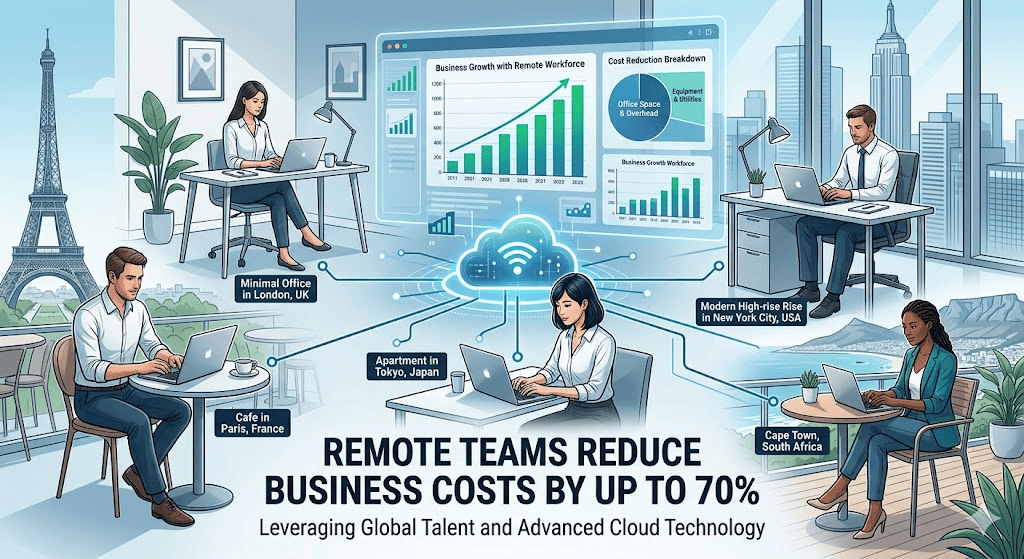
Remote Teams Reduce Business Costs in ways many businesses never imagined possible. Companies around the world are moving away from expensive office-based operations and embracing remote work models that significantly reduce operational expenses while improving flexibility and productivity.
Traditional business operations come with large recurring expenses such as office rent, utility bills, equipment costs, transportation allowances, and employee maintenance expenses. These costs can quickly consume a large portion of a company’s budget, especially for startups and growing businesses.
Remote teams provide a smarter alternative. By adopting a remote workforce strategy, businesses can lower overhead costs, access global talent, and create a more scalable business model. Some organizations have reported reducing overall operating costs by as much as 70%.
Table of Contents
Understanding Traditional Business Expenses
Running a traditional office requires much more than simply paying employee salaries. Businesses typically manage several ongoing operational costs that increase as the company grows.
Common expenses include:
- Office rent or building lease
- Electricity and utility bills
- Internet and communication expenses
- Furniture and office equipment
- Employee transportation benefits
- Office maintenance
- Security systems
- Hiring and recruitment expenses
As businesses expand and hire more people, these costs continue increasing.
For startups and small businesses, such expenses can slow down growth and reduce profitability.
What Are Remote Teams?
Remote teams consist of employees, freelancers, contractors, or professionals who work outside a centralized office location. Instead of working in one building, team members work from their homes or other locations while using digital tools for communication and collaboration.
Remote teams may include:
- Virtual assistants
- Customer support representatives
- Software developers
- Digital marketers
- Designers
- Sales professionals
- Content writers
- SEO specialists
- Account managers
Businesses can build remote teams locally or hire professionals from different countries.
How Remote Teams Reduce Business Costs by Up to 70%
Remote work creates cost savings across multiple areas of business operations.
Instead of reducing only one expense, remote teams affect almost every operational cost category.
Here are the major areas where businesses save money.
Lower Office Space Expenses
Office rent is often one of the largest expenses for companies.
Businesses located in major cities frequently spend thousands of dollars every month on office spaces.
Additional office-related expenses include:
- Maintenance
- Parking
- Furniture
- Cleaning services
- Security
- Repairs
Remote teams eliminate many of these costs entirely.
Instead of paying for a large office, businesses can operate with:
- Small office spaces
- Co-working spaces
- Hybrid offices
- Fully remote systems
For example:
A company paying $4,000 monthly for office space saves approximately:
$4,000 × 12 = $48,000 annually
This amount alone can fund additional hiring or business expansion.
Reduced Utility Bills
Traditional workplaces require continuous spending on:
- Electricity
- Heating systems
- Air conditioning
- Water
- Internet
- Office supplies
These costs may appear small individually, but together they become substantial.
Remote teams significantly reduce these recurring expenses.
Lower utility costs help businesses improve profit margins without affecting productivity.
Lower Equipment and Infrastructure Costs
Physical offices require:
- Desktop computers
- Office desks
- Chairs
- Meeting rooms
- Networking equipment
- Printers
- Storage systems
Remote workers often already possess some required tools, reducing company expenses.
Cloud-based software solutions also decrease infrastructure requirements.
Instead of purchasing expensive servers and hardware systems, companies can use:
- Cloud storage
- Online collaboration platforms
- Virtual communication tools
Reduced Hiring Costs
Hiring employees through traditional methods can be expensive.
Recruitment costs may include:
- Job advertisements
- Recruitment agencies
- Interview arrangements
- Travel expenses
- Office onboarding processes
Remote hiring simplifies much of the process.
Virtual interviews and online onboarding systems reduce hiring expenses significantly.
Businesses can recruit efficiently without geographic limitations.
Access to Global Talent at Competitive Rates
One major advantage of remote teams is access to worldwide talent.
Traditional hiring limits businesses to candidates within specific locations.
Remote hiring expands opportunities across countries and regions.
Businesses can hire:
- Experienced developers
- Virtual assistants
- SEO specialists
- SDRs
- Customer support teams
- Designers
Different regions have varying salary expectations.
Companies can hire highly skilled professionals at competitive rates while maintaining quality.
This strategy creates significant long-term savings.
Lower Employee Turnover Costs
Replacing employees is expensive.
Employee turnover often creates costs such as:
- Recruitment expenses
- Training costs
- Productivity losses
- Management time
Remote work often improves employee satisfaction because people appreciate:
- Flexible schedules
- Better work-life balance
- Reduced commuting stress
- Comfortable work environments
Higher satisfaction can reduce employee turnover rates.
Lower turnover means fewer recruitment costs over time.
Reduced Travel and Transportation Expenses
Traditional office environments involve transportation costs such as:
- Fuel reimbursements
- Travel allowances
- Business trips
- Accommodation costs
- Daily commuting expenses
Remote teams eliminate many of these expenses.
Meetings can happen through:
- Video conferencing
- Online collaboration platforms
- Virtual presentations
Businesses save substantial amounts every year.
Increased Productivity and Efficiency
Many businesses initially worry that remote work reduces productivity.
However, remote work often improves employee performance.
Employees working remotely frequently experience:
- Fewer workplace distractions
- Flexible schedules
- Reduced commuting fatigue
- Better concentration
Higher productivity creates indirect financial savings.
When employees complete tasks efficiently, companies achieve more output without increasing labor costs.
Cost Comparison Between Traditional and Remote Teams
| Expense Category | Traditional Team | Remote Team |
|---|---|---|
| Office Rent | High | Low |
| Utilities | High | Low |
| Equipment | High | Moderate |
| Transportation | High | Minimal |
| Recruitment | Moderate | Low |
| Maintenance | High | Minimal |
| Productivity Losses | Moderate | Lower |
The total cost difference can become substantial over time.
For some businesses, operational savings can approach 70%.
Industries Benefiting from Remote Teams
Remote work benefits many industries.
Technology Companies
Software development teams can operate remotely with ease.
Developers collaborate through online platforms and project management systems.
Digital Marketing Agencies
Marketing tasks naturally fit remote environments.
Examples include:
- SEO
- Content creation
- Social media management
- Advertising campaigns
Customer Support Services
Customer service representatives can provide support from almost anywhere.
E-commerce Businesses
Online businesses frequently use remote teams for:
- Order processing
- Customer support
- Marketing
- Product management
Healthcare Support Services
Healthcare organizations increasingly use remote systems for:
- Scheduling
- Administration
- Telehealth support
Challenges of Remote Teams and Solutions
Remote work offers many benefits, but challenges can occur.
Communication Issues
Poor communication can create confusion.
Solution:
Use communication platforms and regular meetings.
Time Zone Differences
Global teams may work in different time zones.
Solution:
Set overlapping work hours for collaboration.
Employee Engagement Problems
Remote workers may feel disconnected.
Solution:
Conduct virtual team activities and regular check-ins.
Security Concerns
Remote work may increase cybersecurity risks.
Solution:
Use secure systems and access controls.
Essential Tools for Remote Team Management
Successful remote teams rely on technology.
Popular tools include:
Communication Tools
- Slack
- Zoom
- Microsoft Teams
Project Management Tools
- Trello
- Asana
- ClickUp
File Sharing Tools
- Google Drive
- Dropbox
Time Tracking Tools
- Hubstaff
- Time Doctor
These tools help maintain organization and efficiency.
Future of Remote Work and Business Growth
Remote work is no longer a temporary trend.
Businesses increasingly recognize the long-term advantages of flexible work environments.
Future business models will likely include:
- Hybrid workplaces
- Global teams
- AI-powered collaboration
- Remote-first operations
Companies adopting remote work early may gain competitive advantages through lower operational costs and faster scalability.
Final Thoughts
Remote Teams Reduce Business Costs by helping businesses eliminate unnecessary expenses while improving efficiency and scalability. From reducing office expenses and utility costs to accessing global talent and increasing productivity, remote teams create multiple financial advantages.
Organizations that strategically build remote teams can achieve significant long-term savings while creating a flexible work culture that supports growth.
As technology continues evolving, businesses that embrace remote work will likely remain competitive, agile, and better prepared for future market changes.
Featured Image (Main Banner Image)
Placement: Top of article below title
Alt Text:
Remote Teams Reduce Business Costs by up to 70%
Image Prompt:
“Professional modern business illustration showing remote employees working from different locations around the world on laptops, connected through digital lines and cloud technology, cost-saving charts and business growth graphs in the background, corporate style, realistic, clean workspace design, Remote Teams Reduce Business Costs by up to 70% theme.”
Image 1: Traditional Office Costs
Placement: After “Understanding Traditional Business Expenses”
Alt Text:
Traditional business operating costs and expenses
Image Prompt:
“Corporate office with expenses visually represented, office rent, electricity bills, desks, maintenance costs, employees working in a physical office, financial charts showing rising operational expenses, realistic business environment.”
Image 2: Remote Team Collaboration
Placement: After “What Are Remote Teams?”
Alt Text:
Remote teams collaborating globally
Image Prompt:
“Global remote team collaborating through laptops and video calls, people from different countries working from home offices, digital communication screens, modern business environment.”
Image 3: Cost Savings Comparison
Placement: After “How Remote Teams Reduce Business Costs by Up to 70%”
Alt Text:
Remote Teams Reduce Business Costs comparison chart
Image Prompt:
“Professional infographic comparing traditional office expenses versus remote team expenses, office rent, utilities, hiring costs, travel expenses, showing up to 70% cost savings with charts and graphs.”
Image 4: Global Talent Hiring
Placement: After “Access to Global Talent at Competitive Rates”
Alt Text:
Hiring global talent through remote teams
Image Prompt:
“World map with connected professionals from multiple countries, software developers, marketers, virtual assistants, designers working remotely, business hiring global talent illustration.”
Image 5: Productivity and Efficiency
Placement: After “Increased Productivity and Efficiency”
Alt Text:
Remote work productivity growth
Image Prompt:
“Focused employee working from home office setup, productivity graphs increasing on screen, organized desk, modern work environment with business performance metrics.”
Image 6: Remote Team Management Tools
Placement: After “Essential Tools for Remote Team Management”
Alt Text:
Remote team collaboration tools and management
Image Prompt:
“Business dashboard displaying communication tools, project management boards, video meetings, cloud collaboration software interface, modern digital workplace.”
Image 7: Future of Remote Work
Placement: After “Future of Remote Work and Business Growth”
Alt Text:
Future of remote work and business growth
Image Prompt:
“Futuristic remote workplace with AI-powered collaboration, holographic business dashboards, global teams working digitally, modern technology-driven office concept.”